LIGHTHOUSE TRAILS RESEARCH              July 14, 2015      LIGHTHOUSE TRAILS PUBLISHING

Print Friendly and PDF
 
In This Issue - click choice
 

If you would like to print this newsletter, use our new PRINT button up above. In order for it to print right, you will probably have to check the box that says "Remove images.

Lighthouse Trails Research PRINT JOURNAL: Our low-cost subscription-based print journal is mailed out to homes and offices 6 times a year. The 32-page journal contains the most important stories from our e-newsletter from the previous 8 weeks and also other features. You may wish to receive that in addition to this free e-newsletter. You can sign up any time during the year for the print journal. You can also buy individual or past issues here. Many people have now signed up for the print journal, and we are getting very favorable feedback that the journal is most beneficial. For common questions about the journal, click here.

Note: Because we are a research ministry, we do post news articles from various secular and Christian sources along with our own in-house articles if we believe our readers can benefit from the information. We also post video clips from YouTube at times. Also please note, any advertising on YouTube videos is not in any way connected to Lighthouse Trails and is beyond our control, but we make every effort to use only video clips that have no obscene or vulgar content including in advertising.


Christian Colleges Falling Deeper into Apostasy As They Cave in to Supreme Court Ruling

Lighthouse Trails has been tracking Christian colleges, universities, and seminaries for many year now, documenting the steady decline into apostasy as the majority of them have now begun to embrace contemplative spirituality through their Spiritual Formation programs. You can read about this in our booklet/article “An Epidemic of Apostasy – How Christian Seminaries Must Incorporate “Spiritual Formation” to Become Accredited.” That special report we wrote explains how Christian higher-learning institutions are bringing Spiritual Formation into their schools so they can receive accreditation from religious accreditation organizations that are requiring Spiritual Formation. While that isn’t the only reason these Christian schools have succumbed to the dangerous teachings of contemplative spirituality, it certainly has been a main factor. Simply put, without accreditation, these schools won’t get certain benefits and recognition, including money in the form of donations, grants, etc. It also keeps their enrollment down as students typically want to attend schools that are accredited.

Lighthouse Trails has also pointed out on numerous occasions that once a church, school, ministry, or Christian organization begins embracing contemplative spirituality, it’s just a matter of time before that institution begins to change their views on topics such as creation, mysticism, the atonement, salvation through Christ alone, and homosexuality. That’s what getting involved in occultism does to people.

Couple all that with the recent Supreme Court ruling stating same-sex marriage must be recognized throughout America, you have the perfect recipe for the absolute falling away of the majority of Christian colleges.

Quick to jump on the band wagon for accepting the homosexual lifestyle is Baylor University, (the largest Baptist university in the world). According to a July 8th 2015 Time magazine article titled “This University Has Dropped Its Ban on ‘Homosexual Acts,’”  Baylor “dropped a prohibition on ‘homosexual acts’ from its sexual conduct policy”this past May.

But Baylor is not the only one. A Christianity Today article, dated July 8th 2015, titled “Hope College and Belmont to Offer Benefits to Same-Sex Spouses” explains how Belmont University (in TN) and Hope College (MI) are “extending benefits to same-sex spouses of employees after last month’s Supreme Court ruling that legalized same-sex marriage nationwide.” By the way, you can be sure Christianity Today isn’t too upset about these changes—they’ve been promoting the emerging church and contemplative spirituality for a long time.

Wheaton College has already headed down this path showing acceptance of the homosexual lifestyle, and many others will follow suit. And remember, those colleges are training the next generation of pastors and church leaders so the affects will undoubtedly be remarkable.

It appears it is too late to stop the tide of what is happening to Christian colleges. But at Lighthouse Trails, we will continue to send out a warning to parents and grandparents to keep their kids out of these schools and try to find ones that are in a fast-diminishing group of biblically based colleges. At the very least, we hope parents and grandparents will make sure their college-age kids and grandkids are well equipped to live in a world that rejects Christ and in a church that ignores spiritual deception.


Oregon State Silences Bakers Who Refused to Make Cake for Lesbian Couple, Fines Them $135K
Same-sex marriage

Photo: Aaron and Melissa Klein

By Kelsey Harkness
The Daily Signal

Oregon Labor Commissioner Brad Avakian finalized a preliminary ruling today ordering Aaron and Melissa Klein, the bakers who refused to make a cake for a same-sex wedding, to pay $135,000 in emotional damages to the couple they denied service.

“This case is not about a wedding cake or a marriage,” Avakian wrote. “It is about a business’s refusal to serve someone because of their sexual orientation. Under Oregon law, that is illegal.”

In the ruling, Avakian placed an effective gag order on the Kleins, ordering them to “cease and desist” from speaking publicly about not wanting to bake cakes for same-sex weddings based on their Christian beliefs.

“This effectively strips us of all our First Amendment rights,” the Kleins, owners of Sweet Cakes by Melissa, which has since closed, wrote on their Facebook page. “According to the state of Oregon we neither have freedom of religion or freedom of speech.” Click here to continue reading.


“Freedom is Not for Idleness!”

By Pastor Georgi Vins
(Written in the Anyusha Prison Camp in the Urals, USSR, 1969)

“Freedom is Not for Idleness!”

For idleness, we don’t desire freedom,
A holy labor waits in virgin soil!
The melting, ringing song of spring is sounding
And harvest fields are rousing from their sleep.

The holy morning of Christ’s Resurrection
Fills with abundant strength and thrills our breast!
Once more the message of the Gospel’s sounding
Of Him, the One who wakens souls to life.

The persecuted churches meet with gladness!
In many eyes, there glisten tears of joy,
And to our God a gratitude, unending,
Glows with a flaming love in every heart.

My friends, I know how harsh has been the pathway
You passed along, in heavy chains for Christ!
Today you still untremblingly are willing
To walk in far-off places for the Faith.

For idleness, we don’t desire freedom!
We have been called the good news to proclaim,
To serve our people still must be our purpose,
To serve our God—our honor and delight!
April 1969


Letter to the Editor: Rick Warren to Co-Preach Keynote Address at Pope’s U.S.A. Visit in September

Dear Lighthouse Trails:

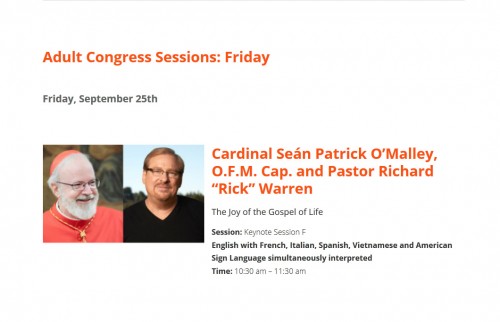
omalley-warrenI thought you might want to know that Rick Warren is going to co-preach the Keynote Address with a priest for Pope Francis’ visit in September 2015. Here is the link to the documentation on that meeting: http://www.worldmeeting2015.org/about-the-event/adult-congress-sessions-thursday-friday/

Thank you for continuing to warn about Rick Warren’s ecumenism, particularly with his joining hands with the current Pope and Catholicism. Thank you for informing your readers that on Nov.19, 2014, “a delegation of Catholic bishops sought ‘wisdom’ from Saddleback on how to use Purpose-Driven methods to propagate their ‘new evangelization,’ which is really no true biblical evangelization at all!” (See link: http://www.lighthousetrailsresearch.com/blog/?p=16405).

In your Nov.19, 2014 blog post, it asked: “Did Rick Warren play a role in getting the Pope to the US, and will Rick Warren play a role in the Pope’s visit to the US. in 2015?”

The answer apparently is: “Yes!” as to whether Rick Warren is going to play a role in the Pope’s visit to the U.S. in September 2015.

Also in your same Nov.2014 blog post, it said that earlier in 2014, a “delegation of Catholic bishops visited Rick Warren and Saddleback to gain some ‘wisdom’ on how to accelerate the Catholic New Evangelization program using Purpose Driven methods.” That same blog also stated: “Perhaps the Pope will make a stop at Saddleback”…

Considering how most hyper-charismatics and heretical groups seem to be convinced a “global revival” will start in California, maybe the Pope might just stop by Saddleback . . . Perhaps a Papal visit to California might deceive more Christians into jumping on the spiritual bandwagon of this “revival” that supposedly will begin in California, as Bethel Church, Jesus Culture, the Sacramento pastors, etc. all have been pushing this false, ecumenical revival idea for quite a while already…

In Christ,
CONCERNED IN CALIFORNIA
LTRP Note: To understand more about Rick Warren’s global P.E.A.C.E. Plan, read Faith Undone by Roger Oakland and A “Wonderful” Deception by Warren B. Smith


Oregon State Silences Bakers Who Refused to Make Cake for Lesbian Couple, Fines Them $135K
“Freedom is Not for Idleness!”
Letter to the Editor: Rick Warren to Co-Preach Keynote Address at Pope’s U.S.A. Visit in September
Contemplative Prayer or the Holy Spirit
Letter to the Editor: What About Jeff Bethke’s Book Jesus > Religion? – A Book With An Agenda!

Letter to the Editor: Supreme Court Justices Trump Constitutional Authority

“Freedom” in America – 21st Century Style: ‘It’s All About Equality': Polygamist Applies for “Marriage” License in Wake of Supreme Court Ruling
New Radio Interview with Jan Markell and Caryl Matrisciana
Seeker Friendly to Contemplative Spirituality
NEW BOOKLET TRACT: Slain in the Spirit: Is it a Biblical Practice? by Kevin Reeves
SIGN UP FOR THE LIGHTHOUSE TRAILS RESEARCH PRINT JOURNAL (not this e-newsletter)
FLAT RATE U.S. SHIPPING AND HISTORY OF LIGHTHOUSE TRAILS
Discernment Detractors: Calling Good Evil

Bryce Homes for Widows and Children in Kenya Lighthouse Trails on Twitter Check out LT Videos on YouTube Visit Lighthouse Trails on Facebook Lighthouse Trails Research Blog

If you are a subscriber to our print journal, click button to renew:

RENEW PRINT JOURNAL

If you are NOT a subscriber to our print journal and want to be, click button to subscribe:

SUBSCRIBE TO LIGHTHOUSE TRAILS RESEARCH PRINT JOURNAL

(The subscribe and renew buttons above are for the print journal delivered to your home, not this free e-newsletter you are reading.)


Who We Are

Lighthouse Trails is a Christian publishing company and research project ministry. We work with a group of Christian journalists and authors, all who understand the times in which we live from a biblical perspective. While we hope you will buy and read the books we have published, watch the DVDs we have produced, and support our ministry, we also provide extensive free research, documentation, and news on our Research site, blog, e-newsletter, and now our subscription based print journal. We pray that the books as well as the online research will be a blessing to the body of Christ and a witness to those who have not yet accepted Jesus Christ as their Savior and Lord.


Contacting Us

Click here for contact information.


BOOKLET TRACTS

In January of 2013, we began publishing Print Booklet Tracts. Click the banner below to see what we have so far. More will be added regularly. These are specifically designed to give out to people and are written by the 35 authors Lighthouse Trails represents.


BOOKLET TRACTS FROM LIGHTHOUSE TRAILS


WRITERS WE USE

Contemplative Prayer or the Holy Spirit

By Ray Yungen

Two authors from Great Britain portray a stunningly clear picture of New Age spirituality. They explain:

[T]he keynote of it appears to be a movement for synthesis derived from an understanding of the underlying unity behind all things and the sense of oneness that this brings.

This oneness of all life is the crux of the New Age movement.17

Catholic monk M. Basil Pennington defined the contemplative spiritual worldview in his book Thomas Merton My Brother. He related:

The Spirit enlightened him [Merton] in the true synthesis [unity] of all and in the harmony of that huge chorus of living beings. In the midst of it he lived out a vision of a new world, where all divisions have fallen away and the divine goodness is perceived and enjoyed as present in all and through all.18

Alice Bailey

Alice Bailey

The first viewpoint describes God as the oneness of all existence. In Merton’s new world, God is perceived as being present “in all and through all.” It certainly appears that the same spirit enlightened both parties. The only difference was Merton’s revelation worked in a Christian context just as occultist Alice Bailey predicted. Unfortunately, this context is now commonplace in Catholic circles, becoming so in mainline Protestant churches, and being eagerly explored and embraced by an ever-increasing number of evangelical Christians.

Evangelical leaders now debate whether such spiritual truths as resting in God are the same as contemplative silence. Based on these presented documentations, I believe contemplative prayer has no place in true Christianity. Scripture clearly teaches that with salvation comes an automatic guidance system—the Holy Spirit. Lewis Sperry Chafer, in his outstanding book Grace: The Glorious Theme, spells out this truth with crystal-clear clarity:

It is stated in Romans 5:5 that “the Spirit is given to us.” This is true of every person who is saved. The Spirit is the birth-right in the new life. By Him alone can the character and service that belongs to the normal daily life of the Christian be realized. The Spirit is the “All-Sufficient One.” Every victory in the new life is gained by His strength, and every reward in glory will be won only as a result of His enabling power.19

Richard Foster

Richard Foster

Show me a Scripture in the Bible in which the Holy Spirit is activated or accessed by contemplative prayer. If such a verse exists, wouldn’t it be the keynote verse in defense of contemplative prayer?

None exists!

I want to emphasize what I believe cuts through all the emotional appeal that has attracted so many to teachers like Richard Foster and Brennan Manning and really boils the issue down to its clearest state.

In his book Streams of Living Water, Richard Foster emanates his hoped-for vision of an “all inclusive community” that he feels God is forming today. He sees this as “a great, new gathering of the people of God.”20

On the surface, this might sound noble and sanctifying, but a deeper examination will expose elements that line up more with Alice Bailey’s vision than with Jesus Christ’s. Foster prophesies:

I see a Catholic monk from the hills of Kentucky standing alongside a Baptist evangelist from the streets of Los Angeles and together offering up a sacrifice of praise. I see a people.21

The only place in “the hills of Kentucky” where Catholic monks live is the Gethsemane Abbey, a Trappist monastery. This also, coincidentally, was the home base of Thomas Merton.

Let me explain this significant connection. In the summer of 1996, Buddhist and Catholic monks met together to dialogue in what was billed the “Gethsemane Encounter.”22 David Steindl-Rast, a Zen-Buddhist trained monk and close friend of Thomas Merton, facilitated this event.

During the encounter, presentations on Zen meditation and practice from the Theravedan Buddhist tradition were offered.23 One of the speakers discussed the “correlation of the Christian contemplative life with the lives of our Buddhist sisters and brothers.”24

For these monks and the Baptist evangelist to be “a people,” as Richard Foster says, someone has to change. Either the monks have to abandon their Buddhist convictions and align with the Baptists, or the Baptists have to become contemplative style Baptists and embrace the monks’ beliefs. That is the dilemma in Foster’s “great gathering of God.”

Mystic David Steindl-Rast once asked Thomas Merton what role Buddhism played in his going deeper into the spiritual life. Merton replied quite frankly: “I think I couldn’t understand Christian teaching the way I do if it were not in the light of Buddhism.”25

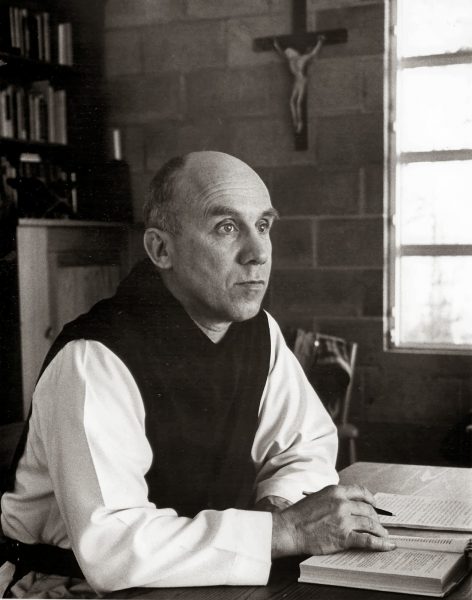
rp_Thomas-Merton.jpg

Thomas Merton

Did Merton mean that in order to understand what Christianity really is, you have to change your consciousness? I believe that is exactly what he meant. Once he personally did that through contemplative prayer, Buddhism provided him with the explanation of what he experienced. But again the catalyst was changing his consciousness. This is what I am warning Christians about. Contemplative prayer is presenting a way to God identical with all the world’s mystical traditions. Christians are haplessly lulled into it by the emphasis on seeking the Kingdom of God and greater piety, yet the apostle Paul described the church’s end-times apostasy in the context of a mystical seduction. If this practice doesn’t fit that description, I don’t know what does.

You don’t have to change your consciousness to grab “aholt” of God (as Brennan Manning insists). All you need is to be born-again. What Steindl-Rast and the other Gethsemane monks should have been telling Buddhists is, “Behold the Lamb of God, which taketh away the sin of the world” (John 1:29).

In his book, Ruthless Trust, Brennan Manning mentions that once Baptist Sunday school teacher, now New Ager, Sue Monk Kidd eventually came under the mentorship of Dr. Beatrice Bruteau who authored the book What We Can Learn From the East. Since that title is self-explanatory, it’s easy to understand why Dr. Bruteau would write the preface to a book like The Mystic Heart by mystic Wayne Teasdale. In the preface, she touts that a universal spirituality based on mysticism is going to save the world.

It seems that all these people want a better world. They do not seem like sinister conspirators like those out of a James Bond film. Yet, it is their niceness that rejects the reality of the fundamental separation between Man and God. It is their sense of compassion that feeds their universalism. It is idealism that makes Manning so attractive and causes him to say that Dr. Bruteau is a “trustworthy guide to contemplative consciousness.”26

The irony of this is that Manning is completely correct in his statement—Dr. Bruteau is a reliable guide to contemplative awareness. She has founded two organizations, the Schola Contemplationis (school for contemplation) and the very Christian-sounding Fellowship of the Holy Trinity. With the latter, she is promoted as “a well-known author and lecturer on contemplative life and prayer.”27 Both of these organizations incorporate Hindu and Buddhist approaches to spirituality. This should come as no surprise because Bruteau also has studied with the Ramakrishna order, which is named after the famous Hindu swami Sri Ramakrishna.

The Ramakrishna order is dedicated to promoting the vision of Sri Ramakrishna. He was known for his view that all the world’s religions were valid revelations from God if you understood them on the mystical level. He was an early proponent of interspirituality. According to the book, Wounded Prophet, Henri Nouwen even viewed him in a favorable light and esteemed him as an important spiritual figure.

Sue Monk Kidd became enamored with contemplative spirituality while attending a Southern Baptist church. We could possibly dismiss that and say she was just an untaught member of the laity who was spiritually lacking in discernment. Maybe her spiritual dryness was a result of her not being grounded firmly enough in the faith. But what about the leaders and pastors whom so many look up to and who are considered trusted individuals in the church? Surely they are able to discern what is spiritually unsound. It seems safe to make this assumption. Right? Unfortunately, this is no longer the case.

 
Letter to the Editor: What About Jeff Bethke’s Book Jesus > Religion? – A Book With An Agenda!

Dear Lighthouse Trails:

I was wondering if you have any info on Bethke’s latest book, Jesus > Religion, or know of anyone who has done a review on it? All I need to know is that Mark Driscoll endorsed it but I have a friend who will want more info… J.C.

Jeff BethkeOur Comment: The book has been out for a while, and yes, we do have a book review on it. This is one book that sure does have an agenda! Here is the book review we wrote in 2013 on Jesus > Religion.

“Anti-Religion Jeff Bethke Hits the News Again – New Book, Same Message: “Imagine No Religion” (From 2013 by LT Editors)

 Not only are there political quests being achieved through the indoctrination of these young people, but these young followers are becoming convinced that a socialistic religion-killing society is the only solution for man.

Jeff Bethke, the 24-year-old man who did the anti-religion YouTube video in 2012, is back in the news again. This time, he has a book about his subject matter. His video, Why I Hate Religion, went viral and to date over 26 million people have viewed it. That video is partially responsible for our writing the Booklet Tract They Hate Christianity But Love (Another) Jesus – How Conservative Christians Are Being Manipulated and Ridiculed, Especially During Election Years (yes, Bethke’s video came out not too long before the nation voted for Obama). You can read our full booklet tract by clicking here, and we hope you do. It may give you a different perspective than what seems to meet the eye. Kind of like when George Barna and Frank Viola came out with their book Pagan Christianity, and untold numbers thought their book was fantastic, when in reality, it was more of a smoke screen to what was REALLY happening in Christianity today (see our article, “Pagan Christianity by Viola and Barna – A Perfect Example of ‘Missing the Point.’” They said a big pagan problem with Christians was that they sat in pews, went to Sunday School, and listened to sermons. But sadly, no mention of the REAL problems happening in the church today (contemplative spirituality, for example).

Here is a portion of our They Hate Christianity But Love (Another) Jesus that gives some background information on Jeff Bethke:

In January of 2012, another election year, a young man, Jefferson (Jeff) Bethke, who attends contemplative advocate Mark Driscoll’s church, Mars Hill in Washington state, posted a video on YouTube called “Why I Hate Religion, But Love Jesus.” Within hours, the video had over 100,000 hits. Soon it reached over 14 million hits, according to the Washington Post, one of the major media that has spotlighted the Bethke video (hits as of May 2013 are over 25 million).

The Bethke video is a poem Bethke wrote and recites in a rap-like fashion his thoughts and beliefs about the pitfalls of what he calls “religion” but what is indicated to be Christianity. While we are not saying at this time that Bethke is an emerging figure, and while some of the lyrics in his poem are true statements, it is interesting that emerging spirituality figures seem to be resonating with Bethke’s message. They are looking for anything that will give them ammunition against traditional biblical Christianity. They have found some in Bethke’s poem. Like so many in the emerging camp say, Bethke’s poem suggests that Christians don’t take care of the poor and needy. While believers in Christ have been caring for the needy for centuries, emerging figures use this ploy to win conservative Christians (through guilt) over to a liberal social justice “gospel.” Emerging church journalist Jim Wallis (founder of Sojourners) is one who picked up on Bethke’s video. In an article on Wallis’ blog, it states:

“Bethke’s work challenges his listeners to second guess their preconceived notions about what it means to be a Christian. He challenges us to turn away from the superficial trappings of “religion,” and instead lead a missional life in Christ.”

Back when we wrote that article, we went pretty easy on Bethke, almost giving him the benefit of the doubt. But Bethke’s new book, Jesus > Religion: Why He Is So Much Better Than Trying Harder, Doing More, and Being Good Enough (Thomas Nelson, 2013) presents Bethke’s views more clearly. For one, he has a  recommended reading list at the back of the book that contains a number of contemplative and emerging advocates such as Mark Driscoll, Brennan Manning, John Piper, Timothy Keller, Brother Lawrence, and John Ortberg. Also on the list are emerging “progressives” like Andy Stanley and N.T. Wright (a figure touted by the emerging church extensively). On a website, Bethke is quoted as saying that Wright is one of his “heroes.”

Interestingly, one of the books Bethke recommends is Beth Moore’s When Godly People Do Ungodly Things. That book is Moore’s declarative statement promoting Brennan Manning, saying that his contribution to “our generation of believers may be a gift without parallel” (p. 72) and that  his book Ragamuffin Gospel is “one of the most remarkable books” (p. 290) she has ever read (Bethke obviously thinks so too – Ragamuffin Gospel is one of his recommended books too). But in the back of Ragamuffin Gospel, Manning makes reference to panentheist mystic Basil Pennington saying that Pennington’s methods will provide us with “a way of praying that leads to a deep living relationship with God.” However, Pennington’s methods of prayer draw from Eastern religions as you can see by this statement by Pennington:

We should not hesitate to take the fruit of the age-old wisdom of the East and “capture” it for Christ. Indeed, those of us who are in ministry should make the necessary effort to acquaint ourselves with as many of these Eastern techniques as possible. Many Christians who take their prayer life seriously have been greatly helped by Yoga, Zen, TM and similar practices. (from A Time of Departing, 2nd ed., p.64)

Manning also cites Carl Jung in Ragamuffin Gospel as well as interspiritualists and contemplatives, Anthony De Mello, Marcus Borg (who denies the virgin birth and deity of Christ), Morton Kelsey, Gerald May, Henri Nouwen, Alan Jones (who calls the atonement vile), Eugene Peterson, and Sue Monk Kidd (who says God is in everything, even human waste and believes in the goddess who offers us the “holiness of everything”). All of these names in Ragamuffin Gospel. It is more than safe to assume that both Moore and Bethke have read (and resonate with) Ragamuffin Gospel. And we know from years of research that Manning was trying to set up the church to become what Karl Rahner “prophesied”: “The Christian of the future will be a mystic or he or she will not exist at all.”

Jeff Bethke

Bede Griffith

We were surprised to see the name Bede Griffith in Bethke’s new book in the endnote section (p. 208). He didn’t necessarily reference him favorably (or unfavorably, for that matter) but the fact that someone like Griffith would be benignly mentioned in a “Jesus” loving book is hard to ignore. The Catholic monk and mystic Bede Griffith, like Thomas Merton, “explored ways in which Eastern religions could deepen his prayer.” (Credence Cassettes, Winter/Lent 1985 Catalog, p. 14, cited in ATOD) Griffith also saw the “growing importance of Eastern religions . . . bringing the church to a new vitality.”(Ibid.) Griffith’s autobiography, The Golden String, expresses his belief that God (the golden string) flows through all things (panentheism).

In reading Bethke’s book, one can see that Mark Driscoll may have rubbed off on him. And one of Bethke’s recommended books is Driscoll’s Vintage Jesus. We wrote a little about that book a number of years ago; we even contacted the late Chuck Smith (founder of Calvary Chapel) and warned him about Driscoll’s book because some Calvary Chapel pastors were trying to bring it in to CC; in Vintage Jesus, Driscoll calls homeschooling “dumb,” mocks the rapture and Armageddon, and says Christians are “little Christs.” Bethke echoes Driscoll’s distain, like in his chapter titled “Religion Points to a Dim Future/Jesus Points to a Bright Future.”  He puts down the kind of believers who see a dismal future for earth (according to Scripture) and says things like:

“God actually cares about the earth, but we seem to think it’s going to burn. God actually cares about creating good art, but we seem to think it’s reserved for salvation messages.” (Kindle Locations 2107-2109, Thomas Nelson).

And just to prove that when Bethke says “religion,” he means biblical Christianity, what other religion is there that “points to a dim future” for planet earth and its inhabitants? Biblical Christianity is the only one that says that the world is heading for judgement because of man’s rebellion against God and because of God’s plan to destroy the devil and his minions. Jesus does point to a “bright future,” but the Bible is very clear that this will not come before He returns; rather He promises a blessed eternal life to “whosoever” believeth on Him. The Jesus Christ of the Bible did not promise a bright future for those who reject Him (and even says that the road to destruction is broad – Matthew 7:13); in fact, Scripture says Jesus Himself was a man of sorrows rejected and despised (Isaiah 53:3). He knew what awaited Him, and He knew what was in the heart of man. But across the board, emergents reject such a message of doom and teach that the kingdom of God will be established as humanity realizes its oneness and its divinity. And they will accomplish this through meditation. In Brennan Manning’s book The Signature of Jesus, he said that “the first step in faith is to stop thinking about God at the time of prayer” (p. 212).  Then the next step, he says, is to choose a sacred word and “repeat the sacred word [or phrase] inwardly, slowly, and often” (p. 218).

Bethke’s book goes after the usual suspects. For instance, he belittles street preachers sharing the Gospel in  his chapter called “Fundies, Fakes, and Other So-Called Christians.” He says:

Whenever I walk by the street preachers, I laugh under my breath, picturing just how uncomfortable they are going to be in heaven when everyone else is partying it up. (p. 43)

Many of those street preachers are the ones responsible for untold numbers ending up in heaven and “partying it up.” It is faithful preachers and evangelists of the Gospel who have tirelessly cried out repent and be saved that will be the reason why some make it to heaven. But it is very typical for emergents to mock and condemn such evangelistic efforts. And if they are reading Ragamuffin Gospel, it’s no wonder they have  a strong aversion to evangelism and a call to repentance. For example, in Ragamuffin Gospel, Manning says that God understands a woman having to become a prostitute in order to support her two- year old son, and He will not condemn her. So, in other words, it really doesn’t matter what we do, as long as we have a good reason for doing it. A relaxed view of sin and a harsh view of evangelism go hand in hand in the emerging church.

And like just about every other emergent-type book, Bethke’s gives a good scolding to Christians who reject our present society’s embracing of homosexuality. He says he believes homosexuality is not God’s perfect plan for man, but can’t we all just have meaningful conversations and get along with each other and stop talking about homosexuality? (pp. 63-69) He actually compares the apostle Paul’s “thorn in the flesh” to being “gay” (p. 69)!

Bethke’s book reminds us somewhat of Mike Erre’s book Death by Church or Dan Kimball’s book, They Like Jesus But Not the Church in the scorning way it portrays conservative Bible-believing Christians and in the way it twists and manipulates Scriptures and biblical ideas, equating them with sinister and evil actions. Like this quote from Bethke:

When people come to us in the midst of their pain, how dare we flippantly quote some Bible verses as if that alone would help? How dare we think we can just send them some balloons? How dare we overspiritualize or be like the mom who told her daughter the rape was her fault? (p. 125)

What he just did there was equate sharing Bible verses with a hurting person to a mom telling her daughter it was her fault she got raped. This constant barrage of attack against biblical Christianity never seems to relent. Remember when Brennan Manning and J.P. Moreland1 used the term “bibliolatry” to say that Christians who put too much focus on the Bible are committing idolatry. And remember when Rick Warren twisted Scripture to tell his readers (in The Purpose Driven Life) that those who think too much about Bible prophecy and the Lord’s return were “not fit for the kingdom of God.”2  We could give example after example of this attack on believers in Christian faith by those who profess to be Christian from one side of their mouth but seek to destroy it from the other side. Erwin McManus is another example: He said that it was his “goal to destroy Christianity”:

My goal is to destroy Christianity as a world religion and be a recatalyst for the movement of Jesus Christ. . . . Some people are upset with me because it sounds like I’m anti-Christian. I think they might be right.3

And on and on it goes. Christians who adhere to biblical beliefs are being beat down and made to look like there is something really wrong with them and they better get with the program.

It’s interesting that in Bethke’s new book, he quotes Rob Bell talking about “the cross” (p. 125).  Interesting because Rob Bell doesn’t believe in the biblical atonement through the Cross. He believes that everyone is going to be saved regardless of their acceptance or rejection of the Cross. So it seems like a strange choice from Bethke; his book just came out this year – surely he has heard of Rob Bell’s beliefs on hell and salvation.

Jeff Bethke

1968: Maharishi Mahesh Yogi with some of his famous followers (left to right) John Lennon, Paul McCartney, the Maharishi, George Harrison, Mia Farrow and Donovan. Photo:THE HINDU ARCHIVES

The “new” Christianity that is being propagated by Bethke, Bell, and countless other voices is not going away. Rather, it is helping to bring about strong delusion and a great falling away. Millions of young people, both Christian and non-Christian, are listening to these voices and following the beat of this drum. They are throwing out the faith of their youth and exchanging it for a “new” spirituality that will produce within them a mindset that rejects the message of the Cross. Not only are there political quests being achieved through the indoctrination of these young people, but these young followers are becoming convinced that a socialistic religion-killing society is the only solution for man. (Remember, Karl Marx said, “religion is the opiate of the masses” and John Lennon of  The Beatles said, imagine no religion).  And, tragically, the masses will continue to race down a broad road to deception through the multitude of false teachers.

Let us remember that before Jesus departed to heaven He commissioned His followers to proclaim the Gospel. The proclamation of the Cross is God’s hope for mankind.The Word of God has been likened to a blacksmith’s anvil; though many a hammer may be broken over the years pounding on that anvil, the anvil will hold its strength and integrity. It is ironic that emergents find comfort in attacking the Gospel and Bible-believing Christians. They say they love Jesus instead. What makes this so very ironic is that the apostle John is referred to in Scripture as “the disciple whom Jesus loved” (John 21:20). Perhaps it would do emergents good to listen to some of the things John had to say – as it seems like his  first epistle was written especially for them. Addressing the idea of loving Jesus (or God) but hating Christianity, John had this to say:

If a man say, I love God, and hateth his brother, he is a liar: for he that loveth not his brother whom he hath seen, how can he love God whom he hath not seen? And this commandment have we from him, That he who loveth God love his brother also. (1 John 4: 20-21)

Now, if we look at the context of the chapter from which these verses were taken, it becomes evident that John is writing about solid doctrinal Christianity. And he is saying that when we hate and reject these things, and the people who adhere to them, we are hating and rejecting God. When they say they love Jesus but hate the church (i.e., Christianity), they aren’t talking about hating buildings; they are talking about hating people. As for the teaching of the Cross, John makes it exceptionally clear in this epistle that “he is the propitiation for our sins” (1 John 2:2):

In this was manifested the love of God toward us, because that God sent his only begotten Son into the world, that we might live through him. Herein is love, not that we loved God, but that he loved us, and sent his Son to be the propitiation for our sins. (1 John 4:9-10)

When we talk about love, we should really be talking about the Cross as this was and is God’s ultimate expression of His love toward us that makes it possible to spend eternity with Him when we receive this gift of love, by faith.

As we look into John’s life more carefully, it becomes apparent that he was not like an emergent at all. While the emergent figures of today seek to be hip and popular and mimic what each other has to say, John stood for the truth regardless of what the masses were saying or wanted to hear. Foxe’s Book of Martyrs records that even though he was the only apostle to escape a violent death, he was cast into a cauldron of boiling oil. And though he escaped miraculously, he was afterward banished to the Isle of Patmos (p. 27, LT edition).

If you are a young person reading this, remember that popularity in the world’s eyes is not a sign of being in God’s favor but is rather an indicator that something may be wrong (see 1 John 4: 5-6). Nor does partying with friends, even if they call themselves lovers of Jesus, offer assurance of eternal life. No, it is through the Cross alone that the offer of eternal life has been extended. And that is the truth!

Letter to the Editor: Supreme Court Justices Trump Constitutional Authority

Dear Lighthouse Trails:

Justice Scalia called the Supreme Court’s decision last Friday [on same-sex marriage] a “judicial Putsch.”1 Webster’s Dictionary defines “Putsch” as being “a secretly plotted and suddenly executed attempt to overthrow a government.”

Last Friday, five Supreme Court justices overthrew our government. The executive branch celebrated with rainbow colored lights on the White House, and Congress did nothing to protest. (Congress has the power to over-ride Supreme Court decisions.) And the “fourth estate” (the press) did nothing to protest, apart from some of the alternative media.

The executive and legislative branch of our government allowed five justices to trump their Constitutional authority. It literally was a coup. The Constitution is now dead. America as we have known it is now gone. It was a bloodless coup, but it was a coup nevertheless.We are now officially a dictatorship, run by Obama and his Supreme Court lackeys.  Congress has become irrelevant and the Constitution has been shredded.

M. 


“Freedom” in America – 21st Century Style: ‘It’s All About Equality': Polygamist Applies for “Marriage” License in Wake of Supreme Court Ruling

By Heather Clark
Christian News Network

HELENA, Mont. — A polygamist in Montana is seeking to obtain a “marriage” license for a second “wife” following last Friday’s U.S. Supreme Court ruling declaring that all 50 states must legalize same-sex nuptials because of the 14th Amendment’s Equal Protection Clause.

“It’s about marriage equality,” Nathan Collier, 46, told The Associated Press this week. “You can’t have this without polygamy.”

Collier went to the Yellowstone County Courthouse on Tuesday with his partner Christine to seek a second marriage license as he stated that if the Supreme Court really believes in equality, then he should have the right to marry as he wishes as well. He cited language from dissenting Chief Justice John Roberts, who stated that the “gay marriage” ruling “would apply with equal force to the claim of a fundamental right to plural marriage.”

“[The majority ruling] offers no reason at all why the two-person element of the core definition of marriage may be preserved while the man-woman element may not,” Roberts wrote. “Indeed, from the standpoint of history and tradition, a leap from opposite-sex marriage to same-sex marriage is much greater than one from a two-person union to plural unions, which have deep roots in some cultures around the world.” Click here to continue reading.

New Radio Interview with Jan Markell and Caryl Matrisciana
Jan Markell

Jan Markell

Caryl Matrisciana

Caryl Matrisciana

Jan Markell recently interviewed Caryl Matrisciana, talking about Caryl’s new documentary film, Wide is the Gate, Volume 3. Jan is founder and director of Olive Tree ministries and a Lighthouse Trails author; Caryl is director and founder of Caryl Productions and a veteran Christian film maker. She is also a Lighthouse Trails author. This interview is a special interview that Olive Tree produced in that Caryl is currently battling cancer, and though she is in a weakened condition believes this topic is so vital that she was willing to do the interview.

To listen to this interview, click here.

To order a copy of Wide is the Gate, Volume 3, click here. We also have Volume 2 and Volume 1 of Wide is the Gate and the bonus DVD from the series Exposing Christian Palestinianism.


Seeker Friendly to Contemplative Spirituality

By Roger Oakland
Understand the Times International

The seeker-friendly model was the brainchild of Peter Drucker. The concept of finding out what a consumer would like in a church has been a very successful way to get people to come to a church. At least for a while! This consumer-friendly model worked as long as sinners were not faced with the message of the cross, hell, and other convicting things the Bible teaches.

However, as everyone knows, trends come and go like waves on the ocean. The seeker-friendly wave will not last forever. This, of course, is predictable. Fallen man has had a spiritual void since the fall of man. Satan is more than happy to fill that void and has always had a deceptive plan to do so. This is why I was not surprised when Pastor Bill Hybels, founder of the Willow Creek church-growth model, announced that their church had repented from their seeker-friendly ways and was now moving towards a method that would transform Christianity by introducing spirituality. Here’s how one Christian reporter explained the transition:

Willow Creek has released the results of a multi-year study on the effectiveness of their programs and philosophy of ministry. The study’s findings are in a new book titled Reveal: Where Are You? co-authored by Cally Parkinson and Greg Hawkins, executive pastor of Willow Creek Community Church. Hybels himself called the findings “earth shaking,” “ground breaking,” and “mind blowing.” And no wonder: it seems that the “experts” were wrong. [1] Click here to continue reading.


NEW BOOKLET TRACT: Slain in the Spirit: Is it a Biblical Practice? by Kevin Reeves

Slain in the Spirit—Is it a Biblical Practice? by Kevin Reeves is our newest Lighthouse Trails Booklet Tract. The Booklet Tract is 14 pages long and sells for $1.95 for single copies. Quantity discounts are as much as 50% off retail. Our Booklet Tracts are designed to give away to others or for your own personal use.  Below is the content of the booklet. To order copies of Slain in the Spirit—Is it a Biblical Practice?,” click here.

Slain in the Spirit—Is it a Biblical Practice?

By Kevin Reeves

Jason had just picked himself up from the floor at the front of the sanctuary and clasped the aged hands of a dear older believer who occasionally came to Sunday service. With a deep reverence, he gently kissed her hands in a gesture of honor.

Only a moment before he had been laid out on the carpet. Sister Carmen had come up front at the service’s end to receive healing prayer for eyes suffering from progressive vision deterioration. She was a sweet old lady, a pioneer who talked a lot about getting back to her home in a small community farther north and deeper into the backcountry. In the previous few months, I had spent considerable time with her and her young companion, a fervent Christian and fellow sticks-dweller who had land staked out for homesteading. A loving and self-appointed protector, he guarded Sister Carmen physically in their travels, and she in turn imparted some of the Christian wisdom gleaned over many years of serving the Lord.

Jason anointed Sister Carmen with oil, and I prayed for her with my eyes closed. I was completely unprepared for what happened next. Sensing a pulling away by Jason, I cracked open my eyelids just in time to see him, frozen in position with his hands outstretched in ministering prayer, free-fall to the hard floor. So stunned that I failed to react, I watched as Jason hit the thin carpeting with a frighteningly loud thump! He lay there in an attitude of sleep while I stood, jaw unhinged and, a ridiculously helpless look on my face. Getting up a few minutes later, Jason said in hushed tones that he had witnessed Jesus overshadowing Sister Carmen.

At the time, I never doubted him, not for a moment. Despite hammering the floor with his head at concussion force, he seemed unhurt, and he was so spiritual about the entire incident that I could barely speak.

Called to the Carpet
Anyone becoming involved with an active charismatic ministry knows what being slain in the spirit means by the end of his first week. It is so common in so many Pentecostal and charismatic services that if it fails to happen for a while, folks engaged in this practice begin to wonder why God’s favor has left them. Experiencing the slain phenomenon for the first time at my old church, New Covenant, I have witnessed it probably hundreds of times in the past twelve years.

But what exactly does being slain in the spirit mean? Traditionally, the term applies to the supposed power of God coming upon a person at a specific time, overpowering his physical strength so that he or she is unable to stand, wherein he or she falls backwards. Sometimes while lying on the floor, the person is totally aware of the experience; at other times individuals claim the power is so intense that all outside influences disappear. Visions are often seen or voices heard during such trance-like states, usually attributed to God. Sometimes the person becomes stuck to the floor, as if held in place by an unseen hand. Some claim to have undergone tremendous spiritual renewal after “falling out,” and still others claim physical healing.

During my years (some of which I was an elder) at New Covenant Fellowship, I believed very strongly in the experience, recommended it to others, and marveled at the power of God that could cut a man’s legs out from under him as with an invisible scythe. I have witnessed entire rows of people go down at the wave of a minister’s hand, bodies collapsing in a disheveled heap on chairs or in the aisles. There were times the anointing seemed to come on me, and I was amazed that I’d lay hands on people or merely walk by them, and they would hit the floor with no warning. The first time this happened, I was awed, deeply grateful that God’s presence had manifested in such a powerful way through so inferior a vessel. I determined to walk more closely with Him, wanting to be used again in this way.

Carnality in Motion
At first, I was very caught up in the excitement, but in later years some disturbing hints began to surface that everything was not as I had first believed. For one thing, a few in our congregation seemed to swoon at the slightest hint of God’s power in the room. Nancy Bullinger was one such, falling out more times than anyone else I knew. I thought it was because she was so sensitive to the things of the Spirit that God just naturally gravitated toward her to demonstrate His presence. But the closer I watched, the more nagging doubts tugged at me. On more than one occasion after she was supposed to be slain, I saw her sit up and pull her skirt down to a discreet level, the hem of which had risen inappropriately when she was laid on the floor by the catcher. She then lay back down and stayed there for a reasonably long period of time. This bothered me. If she was really under the power of God, as we believed, she would have not have had the strength to move, much less be concerned or aware of her modesty.

But this brought up another scriptural inconsistency. I Corinthians 14:40 addresses this concern: “Let all things be done decently and in order.” Many of the women who had skirts or dresses fell with legs askew, exposing skin that should have, in decency, been covered. This obvious immodesty even spawned the ministry of covering in some churches, where specific individuals are assigned the duty of draping prepared cloths over the legs of women indecently exposed. One video of a Kenneth Hagin conference showed one of Hagin’s aides going down to the floor under the power, falling into a sitting woman and sliding down the side of her legs—a woman, mind you, who was not his wife. This scenario was repeated in this video numerous times.1

Would the same God who commanded His people to do all things “decently and in order” also permit—rather instigate—a spiritual practice that places them in physically compromising positions?

Catch Me if You Can
In most services where being slain in the spirit occurs, some members  of leadership are routinely assigned the duty of catcher. Their job is to stay behind the person being prayed for and be prepared to catch, should the individual be overcome, and to lay him gently on the floor while God “ministers.” Since the job can be physically demanding, most of the catchers are men, and, since a great percentage of those slain are women, the catchers must come into abrupt physical contact with the woman’s body. While a catcher is often able to lay hold of the woman’s arms or shoulders, that is sometimes impossible. I have seen some women collapse so quickly and in such a free fall that the catcher has no time to consider appropriate contact, regardless of good intentions. Many people have swooned without prayer of any kind and with no warning beforehand. Those present are faced with the split-second choice of letting the person hit the floor with a thud or laying sudden hold on whatever limbs  or body parts present themselves and lowering the person gently.

Sometimes they are not caught at all. There are simply too many at once responding to “the power,” and they fall one on top of another. During the early ’90s, I witnessed this aplenty, a mass of bodies sprawled out in the aisle, men on top of single women or other men’s wives.

However you slice it, it comes up way short.

I had also been bothered by the very necessity for catchers. If God indeed was knocking His people down, surely He would have the mercy to cushion the fall. In all fairness, I have heard of some who were slain and hit the floor hard, but felt they landed on a bed of feathers. Jason had insisted he was unhurt after his falling out. But that, at best, is subjective. It may or may not have happened the way the person relates the experience. Embarrassment can be a strong silencing factor. Or there may be another reason for that altogether.

But people at times do get hurt, sometimes noticeably. I have personally seen at least one young man go down without realizing no catcher was behind him. He plummeted to the floor and cried out in obvious pain, holding his head. I wonder how many would fall down if they knew nobody would be there to lower them gently. A young church elder visiting our congregation from another town stood behind me as I received prayer during a Sunday service. Noticing I was shaking violently and fighting the urge to fall, he said quietly, “It’s okay, I’m here. You won’t get hurt.”

Of course, I went down.

Context or Pretext?
Where does being slain in the spirit come from? The Bible, presumably. Our favored verse and the one uniformly lifted standard-like by the charismatic community is 2 Chronicles 5:13-14:

[A]s the trumpeters and singers were as one, to make one sound to be heard in praising and thanking the LORD; and when they lifted up their voice with the trumpets and cymbals and instruments of musick, and praised the LORD, saying, For he is good; for his mercy endureth for ever: that then the house was filled with a cloud, even the house of the LORD; So that the priests could not stand to minister by reason of the cloud: for the glory of the LORD had filled the house of God.

Whenever anyone asked for scriptural proof for the validity of being slain in the spirit, we’d trot out this verse with a less-than-humble attitude. And, on the surface, it does look very similar to the modern practice.

There’s just one small difficulty—that’s not the end of the story.

Pastor Ted Brooks, in his devastating critique of modern false signs and wonders within the church, I Was a Flakey Preacher,2 notes that we should continue to read down through chapters six and seven of 2 Chronicles, which is a continuation of this same narrative. Solomon addresses the multitudes present, prays to God, and way over in 2 Chronicles 7:1-2, we find a startling revelation:

Now when Solomon had made an end of praying, the fire came down from heaven, and consumed the burnt offering and the sacrifices; and the glory of the LORD filled the house.

And the priests could not enter into the house of the LORD, because the glory of the LORD had filled the LORD’s house.

The priests were not able to minister in the house of God in the first place because they were not in the house of God at the time. They had come back out and stood with the large gathering of people after setting up the Ark of the Covenant in the holy place. While charismatic teaching would have us believe that the temple was littered with the bodies of incapacitated priests, the Old Testament simply tells us they could not even enter into the area where God had manifested His glory!

A quick reading of 1 Kings 8:10-11 will reveal the same thing. The priests simply were not in the holy place when it was filled with the glory of God.

We must look to Jesus. If He was the Word made flesh (John 1:14), then the entire canon of Scripture is summed up in Him. Not once is it even hinted at in Christ’s ministry that being slain in the spirit ever occurred. It is true that when the soldiers came to take Him in the garden of Gethsemane, He spoke and they all “went backward, and fell to the ground” (John 18:6). But two things must be borne in mind here. For one thing, those who came to take Him were unbelievers and subject to His judgment. In this case, being slain in the spirit is not something to be sought after. Second, the mob didn’t just stay on the ground for a while—they immediately got up again. If Christians are going to use this verse to support being slain in the spirit, it must be used in context with nothing withheld. Seen this way, this particular passage does more damage to the notion than provide support.

Daniel 10:9 has also been used with some success to validate the practice. Confronted by an angelic being, Daniel said “then was I in a deep sleep on my face, and my face toward the ground.”

But again, one must read on to verses ten and eleven:

And, behold, an hand touched me, which set me upon my knees and upon the palms of my hands. And he said unto me, O Daniel, a man greatly beloved, understand the words that I speak unto thee, and stand upright: for unto thee am I now sent. And when he had spoken this word unto me, I stood trembling.

We need to take every word of God at face value. If Daniel says he fell into a deep sleep, we need to accept that without adding to or taking away. If some call this being slain in the spirit, another could as easily say that he simply passed out from fear. The contrasts between this and current practice are rather graphic. When Daniel was touched by the angelic messenger, he received strength to get up. In church when we were “touched by God,” we lost strength. Daniel stood up to face the angel. We lay down so that God could minister. Daniel’s encounter happened through no human agency, and without another witness present. Being slain in the spirit almost always happens under the touch or prayer of an anointed minister, and it is done in public. While it does happen on occasion when a Christian is alone or in prayer, these instances are reportedly rare, and again, subjective. I have seen enough instances, and experienced them myself, to recognize the effects of heightened expectation. The result is often just what the person believed would happen simply because the desire for the experience was so great.

A Visit With “God’s Bartender”
This very thing happened to me in my living room with my wife and daughter present. When Rodney Howard-Browne and his new wine, get-drunk anointing exploded onto the charismatic scene in the early ’90s, both being slain in the spirit and holy laughter roared through our congregation, like wildfire. We grasped any teaching we could get on those subjects. With a five-pack of Rodney Howard-Browne videos, I sat down to glean as much as I could from this man. Since I hadn’t the funds to travel to his itinerant services in Anchorage or Juneau, I reckoned this avenue the next best. I recall being disappointed with his preaching. Watching him maneuver through the congregation I couldn’t see what all the fanfare was about. Mostly he told stories, anecdotes peppered with rehearsed jokes. He talked about the power and mocked those who questioned its origin. I struggled through the teaching because I wanted to get to the “glory.” It was something dangled before me the entire time, and my expectations of being touched rose concurrent with my desire for the power. By the end of his teaching, I was primed, sitting on the edge of the couch.

When he spoke to the congregation and told them to expect the glory to manifest, I looked at Kris, who was combing my daughter Megan’s hair. “I’m going to do it,” I told her gravely, and stood.

I closed my eyes and listened to Browne’s voice as he prayed. Suddenly, the decibel level shot through the roof.

“There it is!” he shouted, meaning the power of God. I listened as he described the anointing, which was supposed to be the manifest presence of God, as it moved up one side of the building and down the other, knocking people to the floor right and left.

When he shouted something like “Take it!” the air was forced out of me in a loud groan, and I fell like a rock back onto the couch. I heard Kris say of Megan, “Kev, you’re scaring her.”

But with my hands still raised and feeling “drunk in the spirit,” I laughed, wept, and felt the power go all over my body, quite unconcerned about who was being frightened. It lasted maybe a half-hour, and when I came out of it, I felt refreshed, a bit awed, and wanting more.

What happened there? An honest appraisal requires me to admit susceptibility to an emotional surge. It wasn’t the power of God. I’ve seen this same form of manipulation in church services (my former church included), whereby recipients are whipped into a fever pitch of expectation. Of course they will go down! That’s what they’ve been waiting for throughout the entire service. It is only natural that they will respond at the appropriate time to the signals given by the man behind the pulpit.

My suspicions finally had an outworking about two years prior to my leaving New Covenant. By that time, having seen so much obvious hype, fakery, and emotionalism, I decided that if God was ever going to knock me down again, then He would be able to do it with my eyes open and my feet planted solidly. Although maintaining a respectful attitude about the entire practice, I was adamant that I would not fall prey to emotional manipulation.

I was never again slain in the spirit.

Whose Anointing?
It is important to understand that all of what goes on in a slain in the spirit service, regarding the actual manifestation, is attributed to the anointing of God. Depending on which River preacher you ask, this anointing can mean power, the weight of glory, the presence of God, or all of the above. While the Bible does refer to an anointing (I John 2:27), it has in these days of sensual faith been contorted almost beyond recognition. And as with so much of hyper-charismatic experience, it has been placed in the realm of something that needs to be reached for, pursued, or worked up in order to be obtained.

Many of today’s biggest superstars in the church have redefined the anointing in a way that brings the experience more into agreement with occult forces than biblical truth. Benny Hinn told of his touch received at the grave of Foursquare founder Aimee Semple McPherson.3 The anointing rests on her bones, he believes, and he shook with the power emanating from her long-dead body. The idea is that visiting these certain graves will give a double-dose of anointing. There’s the “Rambo” anointing of one major Laughing Revival evangelist,4 and the “Braveheart” anointing of Toronto Blessing’s Wes Campbell.5 It doesn’t seem to matter that both Rambo and Braveheart are the main characters of two R-rated movies of gore, mayhem, and foul language. Then there’s Carol Arnott’s “Sword of the Lord” anointing, that makes you shake, cry out, and jerk violently. The video of this specific women’s conference was very revealing.6 I watched in amazement as one of the ladies participating behind the pulpit hefted a huge Scottish broadsword and passed it over the gathering to the congregational accompaniment of wails, groans, and manifestations. This was like something out of ancient Celtic wizardry.

Another major problem in the error-stricken part of today’s charismatic subculture is that some people, usually big-name ministers like Kenneth Hagin, Kenneth Copeland, Benny Hinn, or John Kilpatrick, are looked upon as being more anointed than others. This naturally presupposes the necessity of making a journey to wherever they happen to be ministering in order to be touched by them, and consequently, by God. It is universally recognized by River adherents that the impartation of power is passed from person-to-person via the laying on of hands, and that belief has provoked a virtual scramble among regular church members to get to the preacher that has “it.” It was certainly common practice among New Covenant membership to gravitate toward the most anointed minister who happened to be preaching at our meetings. Long lines formed before the power or prophecy minister, even if there were others less prominent in the visiting ministerial team that might be standing around with nothing to do and no one to pray for after the service.

Today’s River proponents believe also that God moves in particular geographical locations, hence the necessity to get wherever God happens to be in order to get a touch from Him. Places like Toronto and Pensacola have become neo-Medieval pilgrimage destinations, and in fact, people are encouraged to make the journey by many of the front-running River preachers and by their own pastors. And this despite Jesus’ obvious counter to that line of thinking when He told the Samaritan woman that physical locations mattered little in the eyes of God (John 4:21). The Temple made of stones would become obsolete. No more yearly pilgrimage. As long as we worship in Spirit and truth, He will dwell with us and reward us accordingly (John 4:20-24).

A little common sense might help here. What about the poor or those in some far distant corner of our planet who simply believe Christ’s Gospel without knowledge of or desire for the Toronto anointing? Does it leave them out in the cold, or have they missed a necessary move of God? Plus, the fact that so much merchandising unarguably goes on in the form of videos, tee shirts, cassette recordings of worship music, conference fees, skyrocketing pastors’ salaries—ad infinitum—that this current movement bears more of a resemblance to the money changers in the Temple than the humble followers of Jesus.

The Biblical Anointing
So, what, actually, is the anointing? In the Old Testament, it was used to signify the setting apart of an object or the ordaining of an individual for special service to God (Exodus 30:22-30). The anointing oil was specially prepared according to the command of God, and was not to be used for any other purpose or manufactured without regard to God’s specific instructions (Exodus 30:31-33). Kings as well as priests were anointed (1 Samuel 10:1, 1 Samuel 16:13). Elisha was also anointed prophet by Elijah (1 Kings 19:16). The act of pouring out the oil on an individual was used to signify God’s selection, authority, and empowerment for the position.

But with the coming of Jesus Christ, this form of anointing (signifying God’s choice for a position) with oil passed away* and was replaced with the anointing by the Holy Spirit, who Himself has come to live in each believer, empowering us to follow Christ (2 Corinthians 1:21-22). He also is the one who ministers the gifts of the Spirit within the congregation (Romans 12:6-8, 1 Corinthians 12 and 14, Ephesians 4:8-12), and who performs works of miracles (Galatians 3:5) among His people. He leads us into all the truth, and reveals to us the things of God (1 John 2:20, 27). This entire series of Scriptures, and many others on the same subject, shows us that the scriptural anointing is completely different from what is practiced today within the hyper-charismatic circles of which I once participated.

The anointing is not a thing conveniently passed from person-to-person—like getting zapped by a current of electricity a la Rodney Howard-Browne or Benny Hinn. To say, as we so often did in New Covenant Fellowship, “the anointing is now present for healing,” or prophecy, or whatever, is to replace the indwelling Spirit with a physical feeling, emotion, or experience, and to separate Him from His ministry.

This is exactly what is suggested by terms like “getting plugged into the power.” What this kind of thinking promotes is exactly what we are seeing within the River camp, the idea that we need something more than we already possess as believers in Christ. This is precisely the original temptation in the Garden of Eden. Just look in the third chapter of Genesis. The fact is, if the Holy Spirit resides in us (and He isn’t going anywhere), then His power is there as well, to enable us to do what He wants us to do. Anything added to what God has already provided is a counterfeit. We don’t need to get zapped, or experience extra-biblical manifestations in order to feel that we have arrived, or to earn inclusion into the mythical great end-times army of Dominion or Latter Rain doctrine.

Examine the Source
Is there ever a real power at work? I have thought about this one long and hard, because if we admit that there is a genuine supernatural power manifesting, then in light of both the Scriptures and the voluminous evidences of carnality, we must conclude it is a spirit other than the Holy Spirit. Again, if this is so, that can only mean that Christians have opened themselves up to seducing spirits come to lead believers away from the one true God. I have come to the conclusion—very cautiously—that, at times, a real supernatural power is at work. In both River meetings and at the Brownsville Revival, documented testimonies from church leadership have involved vivid descriptions of people lifted bodily by an unseen force and violently thrown across the room and up against walls. Our own Tom Smalley told of being witness to this in one of Howard-Browne’s Anchorage meetings. He’d seen a man well over two hundred pounds thrown back across three rows of chairs at the touch of God’s Bartender. This is scary stuff. And it doesn’t match anything I’ve come across in my Bible about God’s dealings among His faithful covenant people.

I have experienced only two incidents of being slain that felt like a genuine power outside of myself. One was in a local Assembly of God service. A visiting woman preacher laid hands on many who had come forward for prayer, and a mass of them went down. Then it was my turn. Though she never so much as touched me, I felt a numbness sweep over my body, and I fell. On the floor, I shook uncontrollably for about ten minutes. The other time involved a service in my former congregation, again with the aid of a visiting minister. My wife, sitting in one of the pews, described my body contorting backward at a severe angle when the power hit me. To me, they both seemed supernatural. Whether or not that was the case, I will leave for the Lord to decide. If they were indeed supernatural, I now question from which source of power they truly came.

But I have yet to know of anyone, myself included, who, because of being slain experienced a changed life characterized by a love for the truth and a knowledge of God in agreement with the Scriptures. In my experience, the exact opposite has happened. When folks get touched with this kind of power, they routinely become almost unteachable, preferring the experience to the Word of God. I can’t relate how many times I’ve heard, “Well, maybe I can’t find it in the Scriptures, but it happened to me, so it’s real!”

That’s a dangerous step to take. In my many years of involvement with the occult prior to salvation, I had numerous real encounters with the supernatural. Certainly they could not have originated with God, but I once believed some of them did, and to me that was all that mattered. My ears were closed to any protest from Christian friends. Such a stubborn mindset is a fertile seedbed for deception. From just such a people will spring up a world ruler who will lead many to everlasting destruction:

For the mystery of iniquity doth already work: only he who now letteth will let, until he be taken out of the way. And then shall that Wicked be revealed, whom the Lord shall consume with the spirit of his mouth, and shall destroy with the brightness of his coming: Even him, whose coming is after the working of Satan with all power and signs and lying wonders, And with all deceivableness of unrighteousness in them that perish; because they received not the love of the truth, that they might be saved. (2 Thessalonians 2:7-10)

To order copies of Slain in the Spirit—Is it a Biblical Practice?,” click here.

Endnotes:
1. Kenneth Hagin conference video/DVD, “Kenneth Hagin and the Spirit of the Serpent” by Joseph E. Chambers  (Charlotte, NC: Paw Creek Ministries). To order this DVD, 800/338-7884.
2. Ted Brooks, I Was a Flakey Preacher (Westlock, AB, Canada: Guardian Books, 1999).
3. G. Richard Fisher with M. Kurt Goedelman, “Benny Hinn’s Move into Necromancy” citing Benny Hinn sermon, Double Portion Anointing, Part #3, Orlando Christian Center, Orlando, Fla., April 7, 1991. From the series, Holy Ghost Invasion.
4. Mike Oppenheimer citing Rodney Howard-Brown, “The New Anointing” (Let Us Reason ministries,  http://www.letusreason.org/Pent40.htm).
5. “New Year 1998—Where To Now?” article by Christian Witness Ministries (Australia) citing Wes Campbell’s Braveheart speech. (http://www.christian-witness.org/archives/cetf1998/newyear1998.html).
6. Carol Arnott speaking at the Arise Deborah women’s conference in Pensacola, Florida, January 1999, documented by Jewel Grewe, “The Sea of Subjectivity” (Discernment Ministries newsletter, March/April 1999, Volume #2, Issue #10).

To order copies of Slain in the Spirit—Is it a Biblical Practice?,” click here.

Other related resources by Lighthouse Trails:

The Other Side of the River by Kevin Reeves
“I Just Had a Vision!” by Kevin Reeves
The New Age Implications of Bethel Church’s Bill Johnson by John Lanagan
False Revival Coming: Holy Laughter or Strong Delusion? by Warren B. Smith
A Perfect Storm of Apostasy: The Kansas City Prophets and Other Latter-Day Prognosticators by Mary Danielsen
10 Questions for those who claim The “Supreme Beings” of the Nations Are the True God by Sandy Simpson

SIGN UP FOR LIGHTHOUSE TRAILS RESEARCH PRINT JOURNAL - MAILED 6X/YEAR

The Lighthouse Trails Research journal is a subscription-based print journal that can be ordered at any time during the year. Your subscription (which will entitle you to a full twelve months of journals-6 issues) will start when you subscribe. Click here to read more information or click here to sign up. Subscription rate: $12/year (6 issues) for U.S.; $24 for Canada; $38 for other international. (There is no added postage charged for the journal - the mailing costs are worked into the subscription fee.)

When you sign up, you will receive the most current issue of the journal at the time you subscribe. Click here to subscribe now. You can order past subscriptions for $3.

You may purchase subscriptions for friends, family members, pastors, etc. Just put that person's name in the ship to area when ordering online.

Call 866/876-3910 or e-mail sales@lighthousetrails.com.

To order single past issues, click here.

For various addresses, just order single subscriptions,or mail in the addresses and payment.

NOTE: This subscription-based journal can be used in addition to this free e-newsletter you are getting in your e-mail box (the e-newsletter will continue to be sent out 2-4 times a month via e-mail at no charge). (view sample issue of print journal) It's never too late to subscribe for the print journal - anytime is fine.

TO RENEW YOUR SUBSCRIPTION TO THE LIGHTHOUSE TRAILS RESEARCH JOURNAL, CLICK HERE.


If you are a subscriber to our print journal, click button to renew:

RENEW PRINT JOURNAL

SUBSCRIBE TO LIGHTHOUSE TRAILS RESEARCH PRINT JOURNAL

**SPECIAL NOTE ABOUT RENEWING LIGHTHOUSE TRAILS * PRINT* JOURNAL SUBSCRIPTION

If you are a subscriber to the Lighthouse Trails Research Print Journal, it may be time for you to renew your yearly subscription. To RENEW your yearly subscription ($12/year), click here. You can renew your subscription at any time. Just indicate on the store which month you want the renewal to start. If you can't remember when you subscribed, we'll double check when you renew and make sure the renewal starts on the right date. If you have any questions, you can call us at 866-876-3910 or e-mail at editors@lighthousetrails.com. You can also renew by mail (see address at bottom of page), by fax (406-889-3633), or by calling.

Note: This notice does not pertain to this e-newsletter you are reading. The e-newsletter is free and requires no subscription.

Click button to renew your subscription for the Lighthouse Trails Research Journal.

RENEW PRINT JOURNAL

To subscribe to the journal for the first time, click here.

Discernment Detractors: Calling Good Evil

By Warren B. Smith

Woe unto them that call evil good, and good evil; that put darkness for light, and light for darkness; that put bitter for sweet, and sweet for bitter! —Isaiah 5:20

In the first book of Kings, God comes to Solomon in a dream and tells him he can ask for anything that he wants:

In Gibeon the Lord appeared to Solomon in a dream by night: and God said, Ask what I shall give thee. —1 Kings 3:5

Solomon asks for discernment: He wants to be able to discern the difference between what is good and bad—between good and evil. He answers God:

Give therefore thy servant an understanding heart to judge thy people, that I may discern between good and bad: for who is able to judge this thy so great a people? —1 Kings 3:9

God is pleased with Solomon’s request, noting that he asked solely for discernment rather than selfish things for himself:

And God said unto him, Because thou hast asked this thing, and hast not asked for thyself long life; neither hast asked riches for thyself, nor hast asked the life of thine enemies; but hast asked for thyself understanding to discern judgment. —1 Kings 3:10-11

While our Adversary furiously attempts to undermine the importance of discernment by ridiculing it, we are not ignorant of his devices (2 Corinthians 2:11).

SOME OF THE MANY ACCUSATIONS MADE BY DISCERNMENT DETRACTORS

1) If you hate deception and evil and try to expose it, you are a hater—but the Bible says:

The fear of the Lord is to hate evil. —Proverbs 8:13

And have no fellowship with the unfruitful works of darkness, but rather reprove [expose] them. For it is a shame even to speak of those things which are done of them in secret. But all things that are reproved [exposed] are made manifest by the light: for whatsoever doth make manifest is light.—Ephesians 5:11-13

If the world hate you, ye know that it hated me before it hated you. —John 15:18

2) If you contend for the faith, you are contentious—but the Bible says:

Beloved, when I gave all diligence to write unto you of the common salvation, it was needful for me to write unto you, and exhort you that ye should earnestly contend for the faith which was once delivered unto the saints. —Jude 1:3

Fight the good fight of faith, lay hold on eternal life, whereunto thou art also called, and hast professed a good profession before many witnesses. —1 Timothy 6:12

Put on the whole armour of God, that ye may be able to stand against the wiles of the devil. For we wrestle not against flesh and blood, but against principalities, against powers, against the rulers of the darkness of this world, against spiritual wickedness in high places. Wherefore take unto you the whole armour of God, that ye may be able to withstand in the evil day, and having done all, to stand. —Ephesians 6:11-13

3) If you sound an alarm, you are an alarmist—but the Bible says:

Blow ye the trumpet in Zion, and sound an alarm in my holy mountain: let all the inhabitants of the land tremble: for the day of the Lord cometh, for it is nigh at hand. —Joel 2:1

If when he seeth the sword come upon the land, he blow the trumpet, and warn the people. —Ezekiel 33:3

I write not these things to shame you, but as my beloved sons I warn you. —1 Corinthians 4:14

4) If you try to expose heresy, you are a heresy hunter—but the Bible says:

But there were false prophets also among the people, even as there shall be false teachers among you, who privily shall bring in damnable heresies. —2 Peter 2:1

For there must be also heresies among you, that they which are approved may be made manifest among you. —1 Corinthians 11:19

And have no fellowship with the unfruitful works of darkness, but rather reprove them. For it is a shame even to speak of those things which are done of them in secret. But all things that are reproved are made manifest by the light: for whatsoever doth make manifest is light.—Ephesians 5:11-13

5) If you critique false teachings, you have a critical spirit—but the Bible says:

And have no fellowship with the unfruitful works of darkness, but rather reprove [expose] them.—Ephesians 5:11

6) If you name the names of false teachers, you are a name caller—but the Bible names names:

Alexander the coppersmith did me much evil: the Lord reward him according to his works. —2 Timothy 4:14

This thou knowest, that all they which are in Asia be turned away from me; of whom are Phygellus and Hermogenes. —2 Timothy 1:15

And their word will eat as doth a canker: of whom is Hymenaeus and Philetus; Who concerning the truth have erred. —2 Timothy 2:17-18

7) If you exercise righteous judgement, you are considered judgmental—but the Bible says:

Judge not according to the appearance, but judge righteous judgment. —John 7:24

8) If you separate yourself from the things of the world, you are a separatist and into separation—but the Bible says:

Wherefore come out from among them, and be ye separate, saith the Lord, and touch not the unclean thing; and I will receive you. —2 Corinthians 6:17

9) If you think the way is narrow, you are narrow-minded—but the Bible says:

Because strait is the gate, and narrow is the way, which leadeth unto life, and few there be that find it. —Matthew 7:14

10) If you think Jesus is the only way, you are exclusivistic and way off—but the Bible says:

Jesus saith unto him, I am the way, the truth, and the life: no man cometh unto the Father, but by me. —John 14:6

11) If you mark them which cause divisions contrary to doctrine, you are divisive—but the Bible says:

Now I beseech you, brethren, mark them which cause divisions and offences contrary to the doctrine which ye have learned; and avoid them. —Romans 16-17

12) If you warn about deception, you are a deceiver—but the Bible says:

Woe unto them that call evil good, and good evil; that put darkness for light, and light for darkness; that put bitter for sweet, and sweet for bitter!—Isaiah 5:20

Now the next day, that followed the day of the preparation, the chief priests and Pharisees came together unto Pilate, Saying, Sir, we remember that that deceiver said, while he was yet alive, After three days I will rise again.—Matthew 27:62-63

13) If you warn about the wild grapes, you are sour grapes—but the Bible says:

Now will I sing to my wellbeloved a song of my beloved touching his vineyard. My wellbeloved hath a vineyard in a very fruitful hill: And he fenced it, and gathered out the stones thereof, and planted it with the choicest vine, and built a tower in the midst of it, and also made a winepress therein: and he looked that it should bring forth grapes, and it brought forth wild grapes. And now, O inhabitants of Jerusalem, and men of Judah, judge, I pray you, betwixt me and my vineyard. What could have been done more to my vineyard, that I have not done in it? wherefore, when I looked that it should bring forth grapes, brought it forth wild grapes?—Isaiah 5:1-4

14) If you believe Jesus’ prophetic words in the Book of Revelation that the battle of Armageddon will happen one day, then you are a “Doomsday Deceiver”—but the Bible says:

And he gathered them together into a place called in the Hebrew tongue Armageddon.—Revelation 16:16

Blessed is he that readeth, and they that hear the words of this prophecy, and keep those things which are written therein: for the time is at hand.—Revelation 1:3

15) If you say “no” to the false teachings of the world, you are a “naysayer”—but the Bible warns:

But let your communication be, Yea, yea; Nay, nay: for whatsoever is more than these cometh of evil.—Matthew 5:37

16) If you expose Satan (Beelzebub), you are called Satan (Beelzebub) too—but the Bible warns:

It is enough for the disciple that he be as his master, and the servant as his lord. If they have called the master of the house Beelzebub, how much more shall they call them of his household?—Matthew 10:25

ENCOURAGEMENT

Blessed are ye, when men shall revile you, and persecute you, and shall say all manner of evil against you falsely, for my sake. Rejoice, and be exceeding glad: for great is your reward in heaven.—Matthew 5:11-12

Yea, and all that will live godly in Christ Jesus shall suffer persecution. But evil men and seducers shall wax worse and worse, deceiving, and being deceived. But continue thou in the things which thou hast learned and hast been assured of, knowing of whom thou hast learned them; And that from a child thou hast known the holy scriptures, which are able to make thee wise unto salvation through faith which is in Christ Jesus. All scripture is given by inspiration of God, and is profitable for doctrine, for reproof, for correction, for instruction in righteousness: That the man of God may be perfect, thoroughly furnished unto all good works.—2 Timothy 3:12-17


FLAT RATE U.S. SHIPPING AND INFORMATION ABOUT LIGHTHOUSE TRAILS

$5 FLAT RATE SHIPPING ON ALL U.S. ORDERS

(We ship to all countries worldwide.)

FREE BIBLE VERSE TEA SAMPLES WITH EVERY ORDER!Shepherd's Bible Verse Tea - Sampler Box
(except with media rate, journals, and some smaller orders where it might change the shipping costs)


AND DON'T FORGET TO CHECK OUT ALL OUR BOOK AND DVD SETS.
A GREAT WAY TO SAVE!

SOME THINGS ABOUT US:

WHO WE ARE

OUR HISTORY

OUR BELIEFS

LT AUTHOR SITES

NEW TO LT

WHY WE ARE NOT NON-PROFIT

COPYRIGHT AND USE OF MATERIAL


As a way to say thank you to our readers and customers of our catalog and online store, we are offering, indefinitely, to our U.S.A. customers a $5 flat rate shipping on all orders (you can choose a lesser rate for smaller orders). When you get to the third step at check out, just choose the FLAT RATE shipping option. Click here to enter store.